Secondary Market Wines: Opportunities for Smart Wine Investors
What is the Secondary Wine Market?
The secondary wine market is where previously released wines are traded between investors, collectors, and merchants after leaving the primary distribution channels. Unlike the primary market (where wines are first released from producers, including En Primeur futures) or the tertiary market (specialized auctions), the secondary market functions as the main trading arena for fine wines that have already entered circulation.
This market operates much like secondary markets for other assets—imagine the stock exchange but for prestigious bottles of Bordeaux or Burgundy. Just as investors trade shares of Apple or Tesla after their initial public offerings, wine enthusiasts and investors trade bottles of Château Lafite or Domaine de la Romanée-Conti years after their release, when their values have often appreciated significantly.
Market Size and Growth Trends
The global secondary wine market is substantial, estimated at over $5 billion annually. Growth is driven by several factors:
- Expanding investor base, particularly in Asia where newly wealthy collectors are entering the market enthusiastically
- Growing interest in alternative investments as traditional markets face volatility
- Limited supply of investment-grade wines (less than 1% of global production qualifies)
- Increasing wealth in emerging markets creating new demand centers
According to recent industry reports, 64% of wine professionals anticipate market growth in 2025, with particular interest in premium regions like Piedmont (20%), Champagne (17%), and Burgundy (14%). This optimism reflects the resilience of fine wine as an asset class, even during broader economic uncertainty.
Key Secondary Market Hubs
The most active secondary market hubs include:
- UK/London - Home to Liv-ex (London International Vintners Exchange), the world's largest fine wine exchange. London's historical wine trading connections and sophisticated financial infrastructure make it the epicenter of the global secondary market.
- Hong Kong - A tax-free wine hub attracting significant Asian investment since abolishing wine duties in 2008. This policy change transformed Hong Kong into Asia's wine trading center, with auction houses recording record-breaking sales.
- United States - Growing market with increasing collector interest despite tariff challenges. American collectors are particularly active in California cult wines and blue-chip European regions.
How the Secondary Wine Market Works
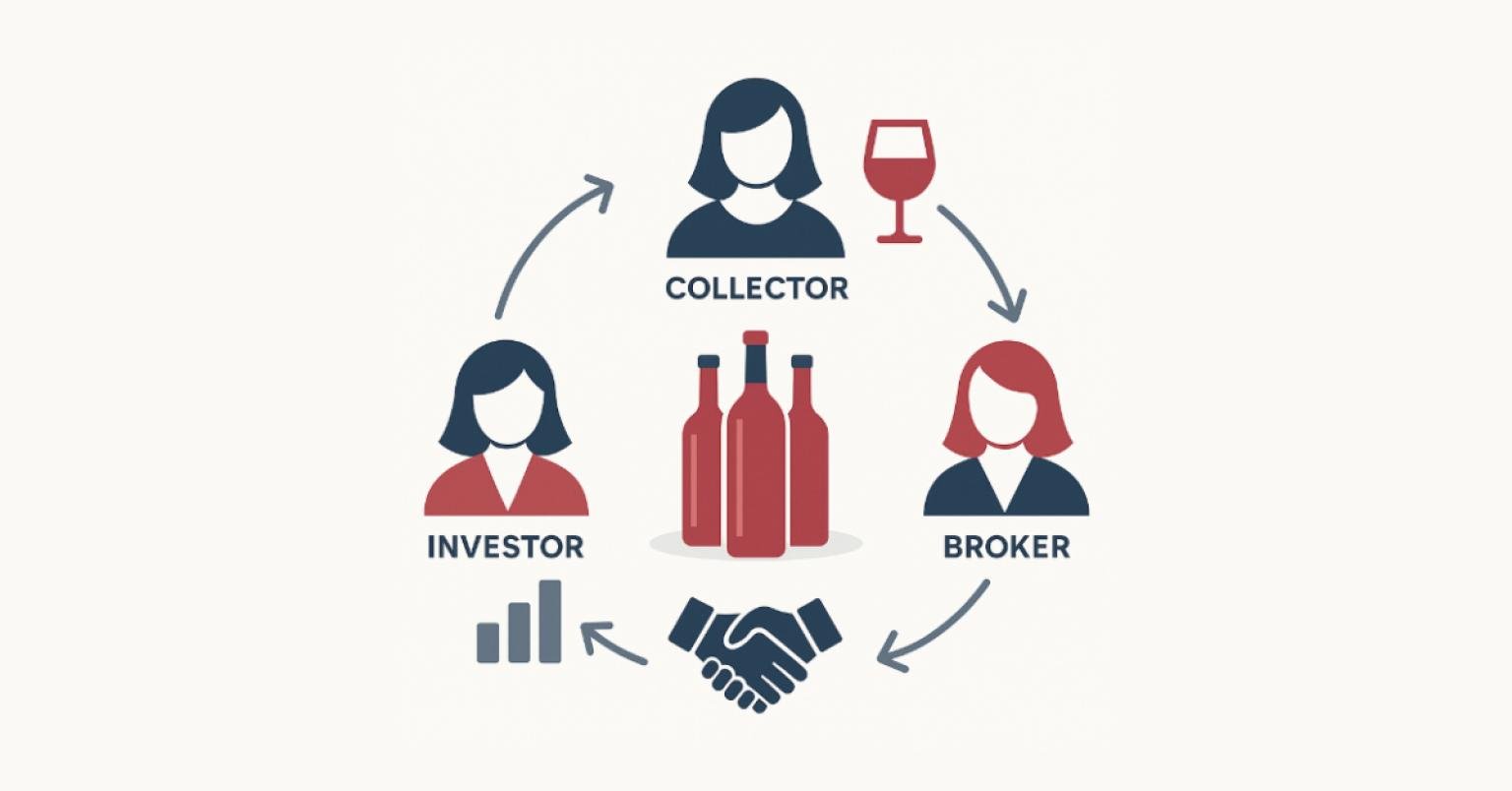
Market Participants
- Investors - Individuals and funds seeking financial returns through wine price appreciation
- Collectors - Wine enthusiasts building personal collections who occasionally sell bottles
- Brokers - Intermediaries connecting buyers and sellers while validating authenticity
- Exchanges - Platforms facilitating transactions with standardized trading practices
- Auction houses - Christie's, Sotheby's, and specialized wine auctioneers creating liquidity for rare bottles
Trading Mechanisms
The secondary market operates through several channels:
- Wine exchanges - Platforms like Liv-ex provide transparent pricing and transaction capabilities, functioning as the "Bloomberg terminal" of wine trading.
- Brokerage platforms - Services like the fine wine broking platform offered by WineFortune connect buyers with sellers while handling authentication, storage, and logistics.
- Private sales - Direct transactions between collectors or investors, often facilitated through collector forums or private networks.
- Merchant networks - Established wine merchants with secondary market operations who maintain inventory and client relationships.
Key Market Drivers
- Scarcity - Limited production of top wines, especially from regions like Burgundy where grand cru vineyards may produce just a few hundred cases annually.
- Aging potential - Wines that improve with time create natural appreciation as drinking windows approach. A young Barolo that needs 15 years to reach maturity naturally appreciates as it approaches its peak drinking window.
- Critical acclaim - High scores from influential critics drive demand, with perfect scores from authorities like Robert Parker historically triggering price increases of 25% or more.
- Brand prestige - Established producers with global recognition maintain consistent demand regardless of vintage conditions.
- Market transparency - Improved data availability through wine investment indices has professionalized trading practices.
Investment Opportunities in the Secondary Market
Regional Focus
While Bordeaux historically dominated the secondary market (96% of trades in 2010), diversification has broadened investment opportunities:
- Bordeaux - Still represents about one-third of secondary market trades, with First Growths (Lafite, Latour, Margaux, Haut-Brion, Mouton Rothschild) serving as market benchmarks.
- Burgundy - Limited production driving exceptional returns (some wines yielding 2000%+ over 15 years). A single bottle of Domaine de la Romanée-Conti's flagship wine can fetch upwards of $20,000, while just two decades ago it traded for under $1,000.
- Champagne - Growing investor interest in vintage offerings from prestigious houses like Dom Pérignon, Krug, and Salon, with the advantage of consistent quality and excellent aging potential.
- Italy - Super Tuscans and Piedmont wines gaining market share, with Sassicaia, Masseto, and Giacomo Conterno's Barolo Monfortino achieving investment-grade status.
- Napa Valley - American icons achieving global investment status, particularly scarce "cult Cabernets" like Screaming Eagle, Harlan Estate, and Opus One.
Investment Approaches
Investors can access the secondary market through:
- Direct bottle/case purchases - Buying specific wines to hold for future appreciation, much like purchasing individual stocks.
- Wine investment funds - Professional management of diversified portfolios, similar to mutual funds in traditional investing.
- Fractional ownership - Platforms allowing partial investment in high-value wines, democratizing access to trophy bottles that might otherwise be unaffordable.
- Wine list memberships - Services like WineFortune's Wine List providing curated access to investment-grade wines with built-in expertise and storage solutions.
Buying and Selling in the Secondary Market
Buying Best Practices
- Verify provenance - Confirm the wine's history and storage conditions. The biography of the bottle is nearly as important as what's inside it.
- Check authenticity - Ensure proper documentation and bottle condition. Sadly, counterfeiting is a real concern at the high end of the market, making trusted sources essential.
- Understand pricing - Research recent sales of comparable wines. Tools like Liv-ex indices or WineFortune's market data can provide benchmarks.
- Consider storage - Plan for professional storage to maintain value. A perfectly stored case from an average vintage will outperform a poorly stored case from an exceptional vintage.
- Factor in costs - Account for transaction fees, storage, and insurance. These overhead expenses typically run 2-3% annually of the collection's value.
Selling Strategies
- Timing the market - Consider selling when wines reach drinking maturity. For example, premium Bordeaux typically hits its investment sweet spot between 10-15 years of age.
- Choose the right channel - Select between exchanges, brokers, or auctions based on the wine's rarity and your timeline. Auction houses excel at selling extremely rare bottles, while brokers offer faster liquidity for more common investment wines.
- Present proper documentation - Provide provenance and storage history. Detailed records can increase value by 10-20% compared to identical wines with uncertain histories.
- Set realistic pricing - Based on current market conditions. Pricing too aggressively can leave wines languishing unsold, while appropriate pricing ensures liquidity.
- Consider liquidity - Some wines sell more quickly than others. Blue-chip Bordeaux typically offers the highest liquidity, while obscure regions may require patience.
Cost Considerations
When investing in the secondary market, be aware of these wine investment costs:
- Transaction fees - Typically 5-15% for brokers, 20-25% for auctions (split between buyer and seller premiums)
- Storage costs - Professional facilities charge $1-5 per bottle annually for temperature and humidity-controlled storage
- Insurance - Usually 0.5-1% of collection value annually to protect against damage or loss
- Management fees - For funds or managed services (1-3% typical), similar to traditional investment management fees
Risks and Challenges
The secondary wine market presents specific risks:
- Authenticity concerns - Counterfeit wines exist, particularly for rare bottles. The infamous case of wine counterfeiter Rudy Kurniawan, who sold millions in fake rare Burgundies, highlights this risk.
- Storage issues - Improper storage can damage wine and reduce value. A temperature spike above 80°F can permanently damage fine wine, making professional storage essential.
- Market volatility - Prices fluctuate based on critic scores, vintage quality, and economic conditions. The 2008 financial crisis, for example, temporarily depressed fine wine prices by 20-30%.
- Liquidity challenges - Selling can take time, especially for niche wines. While top Bordeaux might sell within days, obscure regions or producers might require months to find buyers.
- Knowledge barriers - Expertise is required to identify the best wine for investment. The wine world's complexity means novice investors can easily make costly mistakes.
WineFortune's Secondary Market Solutions
WineFortune offers several ways to participate in the secondary wine market:
- Fine Wine Investment Fund - Starting from just €1, targeting 13%+ annual returns with professional management. This democratizes access to wine investment for those who lack the capital for traditional case investments.
- Wine List Membership - Access to exclusive fine wines in perfect drinking windows, combining investment potential with enjoyment opportunities.
- Fine wine marketplace - Platform for buying and selling investment-grade wines with authentication guarantees and secure transactions.
- Wine portfolio management - Expert guidance on building and maintaining a wine portfolio, balancing risk, return, and personal preferences.
Getting Started in the Secondary Wine Market
For investors new to the secondary wine market:
- Educate yourself - Learn about regions, producers, and vintages. Understanding why Château Margaux 2015 trades at a premium to the 2014 requires knowledge of both the producer and the vintage conditions.
- Start small - Begin with modest investments to understand the market. Even blue-chip wines are available in single bottles, allowing for gradual portfolio building.
- Diversify - Spread investments across regions and vintages. A portfolio mixing Bordeaux, Burgundy, and Champagne offers both stability and growth potential.
- Leverage expertise - Consider platforms with expert curation. The cost of expert guidance is typically far less than the cost of investment mistakes.
- Take a long view - Wine investment typically rewards patience (5-10 years). Unlike cryptocurrencies or tech stocks, wine appreciates gradually as it matures.
Conclusion
The secondary wine market offers unique opportunities for investors seeking portfolio diversification, potential appreciation, and the enjoyment of a tangible asset. With proper research, careful selection, and patience, this market can deliver both financial returns and the pleasure of fine wine.
Whether you're investing through a fund, building a personal collection, or seeking a blend of both approaches, understanding the dynamics of the secondary market is essential for success in fine wine investment. After all, wine might be the only investment you can drink if the market turns against you!
Read next
Top Investment Wine Brands Worldwide That Deliver Serious Portfolio Value
Investment-grade wines have emerged as a compelling alternative asset class, offering both portfolio diversification and the unique pleasure of potentially enjoying your investment. For retail and alternative asset investors looking...
Wine Investment Strategies: Uncorking Returns in a Volatile Market
Fine wine investment offers a compelling blend of portfolio diversification, steady growth potential, and the unique pleasure of possibly enjoying your asset. With the global wine market projected to reach...
Wine Investment Risks and Strategies for Smarter Risk Management
Fine wine investment offers attractive returns averaging 10% annually since 1988, but like any investment, it comes with distinct risks that require careful management. Understanding these risks and implementing effective strategies within...